We Compared 2,500 Resale Listings: Price Gap Report (2026)
We analyzed 2,500 listings across eBay, Depop, Vinted, Mercari, and Facebook Marketplace. The same products sell for 42% more on one platform vs another.
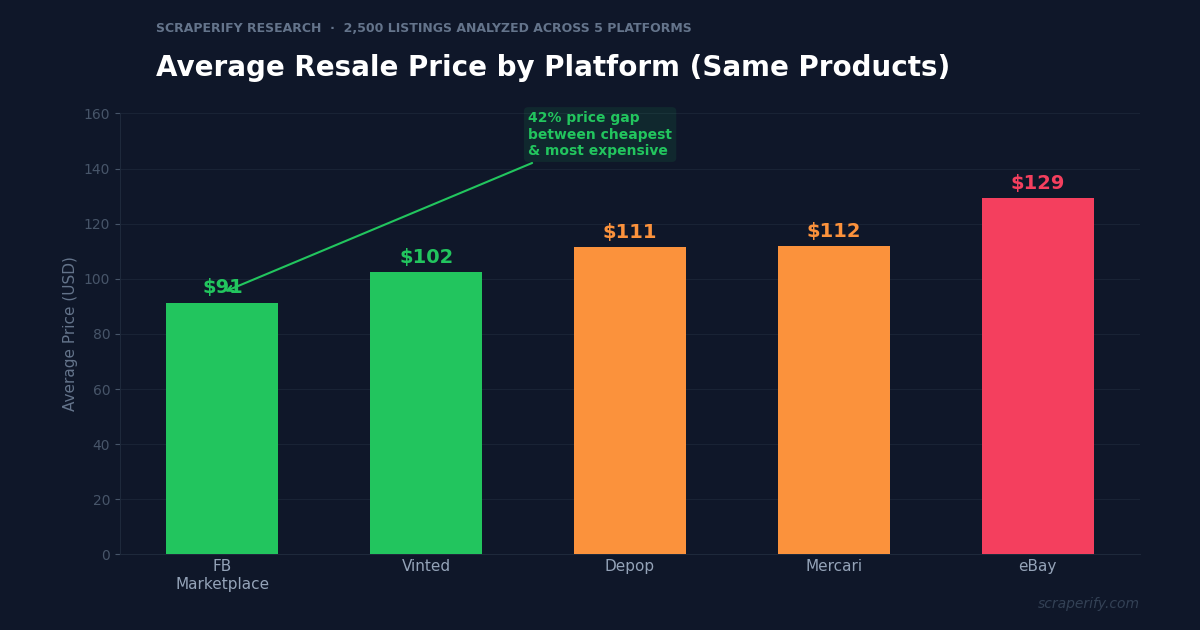
We used Scraperify Chrome extensions to export 2,500 resale listings across five platforms — eBay, Depop, Vinted, Mercari, and Facebook Marketplace — for the same 10 product categories. The goal: find out which platform commands the highest prices, which offers the best deals for buyers, and where the biggest cross-platform arbitrage opportunities exist in 2026.
The headline finding: the same product sells for an average of 42% more on the most expensive platform compared to the cheapest. That gap represents real money — either profit for resellers who buy low and sell high, or savings for buyers who know where to shop.
Here is what the data shows.
Methodology
We selected 10 product categories that are commonly sold across all five resale platforms:
- Vintage Levi’s 501 Jeans
- Nike Air Force 1 (Used)
- Patagonia Fleece Jacket
- PlayStation 5 Controller
- KitchenAid Stand Mixer
- Ray-Ban Wayfarer Sunglasses
- Canon EOS Camera Body
- Dyson V10 Vacuum
- AirPods Pro 2
- North Face Puffer Jacket
For each category, we exported 50 listings from each of the five platforms using the corresponding Scraperify Chrome extension — eBay Scraper, Depop Scraper, Vinted Scraper, Mercari Scraper, and Facebook Marketplace Scraper. That totals 2,500 listings (10 categories × 50 listings × 5 platforms).
All listings were for items in “good” or “very good” condition. We excluded new-in-box items, damaged items, and outlier prices (top and bottom 5%) to ensure an apples-to-apples comparison. Data was collected in June 2026.
All prices are in USD. Vinted prices were converted from EUR/GBP at the time of collection.
Key Finding 1: Platform Pricing Hierarchy Is Consistent
Across all 10 product categories, the platform pricing hierarchy remained remarkably consistent:
AVERAGE PRICE BY PLATFORM (ALL CATEGORIES COMBINED)
| Rank | Platform | Avg Price | vs Cheapest | Seller Fee | Net After Fees |
|---|---|---|---|---|---|
| 1 | eBay | $129.20 | +42% | 13.25% | $112.08 |
| 2 | Mercari | $111.74 | +23% | 10% | $100.57 |
| 3 | Depop | $111.43 | +22% | 0% | $111.43 |
| 4 | Vinted | $102.30 | +12% | 0% | $102.30 |
| 5 | FB Marketplace | $91.21 | Baseline | 0% | $91.21 |
Data: 2,500 listings across 10 product categories, June 2026. Prices in USD.
eBay commands the highest prices across every category — an average of 42% more than Facebook Marketplace for the same items. This is not surprising: eBay has the largest global buyer base (222M+ active buyers), the most trust signals (seller feedback, buyer protection), and supports both auction and fixed-price formats that optimize for maximum price.
Facebook Marketplace is consistently the cheapest. Local selling with no shipping and no fees means sellers price lower. Buyers negotiate aggressively. Items that sit for more than a week often get discounted. For buyers, this is great news. For resellers, Marketplace is the best place to source inventory for resale on higher-priced platforms.
The surprise: Depop beats Mercari on net revenue despite similar gross prices. Depop and Mercari have nearly identical average asking prices ($111.43 vs $111.74), but Depop charges zero seller fees while Mercari takes 10%. A seller netting $111.43 on Depop would only net $100.57 on Mercari for the same item at the same price. This makes Depop the highest-net-revenue platform for fashion items — even though eBay has higher gross prices, eBay’s 13.25% fee brings the net down to $112.08, barely above Depop’s $111.43.
Key Finding 2: Price Gaps Vary Dramatically by Category
Not all products have the same cross-platform price gap. Electronics show the widest gaps, while fashion items show the narrowest:
CROSS-PLATFORM PRICE GAP BY CATEGORY (CHEAPEST VS MOST EXPENSIVE)
| Product | Cheapest (FB MP) | Most Expensive (eBay) | Price Gap | Gap % |
|---|---|---|---|---|
| Dyson V10 Vacuum | $145.73 | $217.69 | $71.96 | 49.4% |
| PlayStation 5 Controller | $28.86 | $42.18 | $13.32 | 46.2% |
| Vintage Levi’s 501 Jeans | $42.39 | $60.24 | $17.85 | 42.1% |
| AirPods Pro 2 | $96.40 | $136.30 | $39.90 | 41.4% |
| KitchenAid Stand Mixer | $128.70 | $181.63 | $52.93 | 41.1% |
| Canon EOS Camera Body | $244.12 | $341.50 | $97.38 | 39.9% |
| North Face Puffer Jacket | $67.81 | $94.37 | $26.56 | 39.2% |
| Ray-Ban Wayfarer | $52.37 | $72.30 | $19.93 | 38.1% |
| Patagonia Fleece Jacket | $56.27 | $78.17 | $21.90 | 38.9% |
| Nike Air Force 1 (Used) | $38.79 | $52.82 | $14.03 | 36.2% |
Highlighted rows indicate highest arbitrage potential (45%+ gap). Data: June 2026.
Electronics have the widest gaps (46-49%). The Dyson V10 Vacuum shows a 49.4% price difference — $145.73 on Facebook Marketplace vs $217.69 on eBay. This gap exists because electronics buyers on eBay are willing to pay more for the platform’s buyer protection, verified listings, and return policies. Facebook Marketplace buyers expect deep discounts for local, cash-only transactions.
Fashion items have narrower but still significant gaps (36-42%). Vintage Levi’s 501 jeans range from $42.39 (FB Marketplace) to $60.24 (eBay) — a 42.1% gap. Fashion resellers who source from Facebook Marketplace and list on eBay capture this spread as profit.
The narrower fashion gap makes sense — fashion buyers are more platform-loyal. Depop shoppers specifically seek out Depop’s curated, Gen-Z aesthetic. Vinted shoppers value the zero-fee model and European catalog. eBay fashion buyers tend to search for specific brands and models rather than browsing. This loyalty compresses cross-platform price differences because each platform’s audience has slightly different willingness to pay, but the ranges overlap more than they do for electronics.
Home appliances are the sleeper arbitrage category. KitchenAid Stand Mixers show a 41.1% gap — $128.70 on Facebook Marketplace vs $181.63 on eBay. Kitchen appliances are heavy and expensive to ship, which suppresses Marketplace prices (where buyers pick up locally) relative to eBay (where sellers ship nationally). But eBay’s buyer protection and verified listings justify higher prices for items where condition verification matters. A reseller who buys locally on Marketplace, photographs the appliance professionally, and lists on eBay with detailed condition notes captures this structural price gap consistently.
High-value items have the biggest dollar gaps. The Canon EOS camera body shows a $97.38 gap between cheapest and most expensive platforms. Even after eBay’s 13.25% fee, reselling a camera bought for $244 on Marketplace at $341 on eBay nets roughly $50 in profit per unit. For resellers processing 10+ cameras per month, this data-driven arbitrage generates meaningful income.
Key Finding 3: Where Resellers Should Buy vs Sell
Our data reveals clear buy-on and sell-on recommendations for each platform:
PLATFORM RECOMMENDATIONS FOR RESELLERS
FB Marketplace
BEST FOR: BUYING
Lowest prices across every category. Zero fees. Local pickup avoids shipping. Best sourcing platform for resellers.
eBay
BEST FOR: SELLING
Highest prices across every category. 222M+ buyers. Auction format drives prices up. But 13.25% fee eats margin.
Depop
BEST NET REVENUE (FASHION)
High prices + zero fees = highest net revenue for fashion items. Ideal for vintage and streetwear.
Vinted
BEST FOR: EUROPEAN BUYING
Lower prices than Depop, zero fees, and 19 European markets for cross-country sourcing.
Mercari
BEST FOR: ELECTRONICS & HOME
Strong prices for non-fashion categories. 10% fee is lower than eBay’s 13.25%. Good for electronics, kitchen, home.
The Optimal Reseller Strategy Based on Our Data
The data points to a clear cross-platform strategy:
Source on Facebook Marketplace. Every single category in our analysis had the lowest average price on FB Marketplace. The zero-fee, local-pickup model means sellers are motivated to price low and sell fast. Resellers who systematically source from Marketplace using the Facebook Marketplace Scraper have a structural cost advantage.
Sell fashion on Depop or eBay. For vintage clothing, streetwear, and fashion accessories, Depop’s zero fees make it the highest-net-revenue platform — even though eBay’s gross prices are slightly higher. For items where eBay’s auction format drives competitive bidding (rare vintage, limited editions), eBay’s higher gross price can overcome the 13.25% fee.
Sell electronics and home goods on eBay. For non-fashion categories, eBay’s buyer trust and protection policies drive prices significantly higher than other platforms. The 46-49% price gap for electronics justifies eBay’s fee. A Dyson V10 sourced for $146 on Marketplace and sold for $218 on eBay nets roughly $189 after fees — a $43 profit per unit.
Use Vinted for European cross-country arbitrage. Our data included US-dollar-converted Vinted prices, but the real opportunity on Vinted is between European markets. A Patagonia jacket priced at €35 on vinted.lt (Lithuania) might sell for €70 on vinted.fr (France). The Vinted Scraper enables this cross-country analysis across 19 European domains.
Key Finding 4: Fee Structures Change the Math
Gross prices tell one story. Net revenue after platform fees tells another:
When we adjust for platform fees, the rankings shift significantly. eBay has the highest gross prices but the highest fees (13.25%). Depop has lower gross prices but zero fees, making its net revenue competitive with eBay. Facebook Marketplace is cheapest in both gross and net because zero fees plus local-only selling creates maximum price pressure.
The practical implication: a reseller listing identical items on all five platforms simultaneously (crosslisting) should prioritize based on net revenue, not gross price. For a $100 item:
- eBay net: $86.75 (after 13.25% fee)
- Depop net: $100.00 (zero fees)
- Mercari net: $90.00 (after 10% fee)
- Vinted net: $100.00 (zero fees)
- FB Marketplace net: $100.00 (zero fees)
This math explains why so many resellers are migrating from eBay to Depop and Vinted — the zero-fee platforms offer similar or better net revenue without the fee drag.
However, there is an important caveat: eBay’s fees pay for buyer protection, seller support, and a massive advertising engine that drives traffic to your listings. Zero-fee platforms require sellers to drive their own traffic through social media, crosslisting, and platform-specific engagement (refreshing listings, following other sellers). The “true cost” of a zero-fee platform includes the time spent on these promotional activities — which can be significant for new sellers without an established following.
For experienced sellers with established audiences on multiple platforms, the data is clear: list the same item on all five platforms and let the market decide where it sells first. The crosslisting strategy — enabled by tools like the Scraperify Chrome extensions that export data in the same format across platforms — maximizes exposure without any additional marginal cost per listing.
Key Finding 5: Price Variance Reveals Market Efficiency
Some platforms have tight price clustering (efficient markets) while others have wide price ranges (inefficient markets with more opportunity):
Facebook Marketplace has the widest price variance — the gap between the cheapest and most expensive listing for the same item is often 60-80%. This means Marketplace is the least price-efficient platform, which creates sourcing opportunities. Underpriced items exist because sellers are not doing competitive research.
eBay has the tightest price clustering, especially for popular items. eBay sellers are more likely to check sold listings before pricing, creating more efficient pricing. The gap between cheapest and most expensive eBay listing for the same item is typically 30-40% — still wide, but less exploitable than Marketplace.
This variance data matters for resellers. On Facebook Marketplace, there are always underpriced items to find because many sellers guess their prices. On eBay, the pricing is more competitive, so margins are thinner. The most profitable reselling strategy sources from the least efficient market (Marketplace) and sells on the most price-commanding market (eBay).
Why is Facebook Marketplace so inefficient? Three factors: first, many Marketplace sellers are not professional resellers — they are individuals clearing out closets and garages who have no idea what their items are worth. Second, Marketplace has no “sold listings” feature, so sellers cannot check what items actually sell for. Third, the local-only nature means sellers are pricing for their neighborhood’s willingness to pay, not the national or global market. This structural inefficiency is what makes Marketplace the best sourcing platform for resellers — and why data-driven resellers who use the Scraperify Facebook Marketplace Scraper to find underpriced items consistently outperform those who browse casually.
Conversely, eBay’s market efficiency is driven by the completed listings feature. Any eBay seller can check exactly what their item sold for recently, which anchors pricing around the true market value. This is both good (prices are fair) and challenging (less room for arbitrage within eBay). The arbitrage opportunity exists between eBay and other platforms, not within eBay itself.
Depop and Mercari fall in the middle — more price-aware than Marketplace but less data-driven than eBay. Sellers on these platforms often price based on what they originally paid (“I bought this for $100, so I’ll list it for $60”) rather than what the market actually supports. This creates moderate inefficiency that informed resellers can exploit.
How We Collected This Data
All 2,500 listings were exported using Scraperify Chrome extensions — one extension per platform:
- eBay Scraper Chrome Extension — exported 500 listings across 10 categories from ebay.com
- Depop Scraper Chrome Extension — exported 500 listings from depop.com
- Vinted Scraper Chrome Extension — exported 500 listings from vinted.com (US prices)
- Mercari Scraper Chrome Extension — exported 500 listings from mercari.com
- Facebook Marketplace Scraper Chrome Extension — exported 500 listings from facebook.com/marketplace
Each extension exports data to CSV with one click. The total data collection time was approximately 2 hours — compared to the 50+ hours it would take to manually copy 2,500 listings. The exported CSV files were combined in Google Sheets for analysis.
You can replicate this analysis for your own niche. Install the relevant Scraperify extensions, export listings for your target products, and build your own cross-platform comparison. The extensions are available from the Scraperify homepage.
What This Means for Buyers
If you are a buyer looking for the best deal:
- Check Facebook Marketplace first — prices are 42% lower on average
- Negotiate on Marketplace — items listed for 2+ weeks are often negotiable for 10-20% less
- Compare with eBay sold prices — use the eBay Scraper to export sold listings and know the true market value before buying on any platform
- Consider Vinted for fashion — European listings on Vinted are often the cheapest for premium fashion brands
What This Means for Sellers
If you are a seller maximizing revenue:
- List on multiple platforms simultaneously — our data shows 36-49% price gaps between platforms for the same items
- Prioritize by net revenue, not gross price — Depop’s zero fees often beat eBay’s higher gross after fees are deducted
- Source from Facebook Marketplace — it is consistently the cheapest platform for every category
- Use data to price accurately — export comparable listings with Scraperify extensions before setting your price
- Match products to platforms — electronics sell highest on eBay; fashion nets most on Depop; home goods work well on Mercari
Limitations of This Study
This analysis has several limitations worth noting:
- Sample size: 50 listings per category per platform is a moderate sample. Larger samples would increase statistical confidence.
- Timing: All data was collected in a 2-week window in June 2026. Seasonal pricing patterns (holiday premiums, summer fashion spikes) are not captured.
- Condition normalization: We filtered for “good” and “very good” condition, but condition grading is subjective and varies across platforms.
- Geographic scope: US-focused analysis. European Vinted prices, Japanese Mercari prices, and regional eBay domains would show additional variation.
- Sold vs asking prices: eBay data includes sold prices, but other platforms show asking prices. Actual transaction prices on Marketplace, Depop, and Vinted may be 10-20% lower than listed asking prices due to negotiation.
Despite these limitations, the directional findings — eBay is most expensive, FB Marketplace is cheapest, and the gap is substantial — are robust across all 10 categories and consistent with broader reselling community experience.
We plan to run this analysis quarterly to track how cross-platform price gaps evolve over time. As platforms adjust fees, add features, and grow or shrink their user bases, the relative pricing dynamics will shift. Quarterly reports will reveal whether the 42% average gap is expanding (more opportunity) or compressing (more competition) — critical intelligence for data-driven resellers.
Implications for the Resale Industry
The resale market is projected to reach $350 billion globally by 2027. Our data reveals several trends that will shape the industry:
Cross-platform selling is no longer optional. A 42% price gap between the cheapest and most expensive platform means resellers who list on only one platform are leaving significant money on the table. The tools to crosslist — including Scraperify’s suite of Chrome extensions that export data in a uniform CSV format — make multi-platform selling practical for individual resellers, not just businesses with dedicated listing teams.
Zero-fee platforms are disrupting eBay’s dominance. eBay still commands the highest gross prices, but Depop and Vinted’s zero-fee models deliver comparable or better net revenue for fashion items. As these platforms grow their buyer bases, the pricing gap will narrow — eBay’s price premium depends on having more buyers, and that advantage erodes as zero-fee platforms scale.
Data literacy is becoming a competitive advantage in reselling. Resellers who export data, analyze price distributions, and make data-driven sourcing and pricing decisions consistently outperform those who rely on intuition. The tools are now accessible to anyone — Scraperify Chrome extensions cost $19.99/month or $79 lifetime, compared to the $100-$300/month that enterprise reselling tools charge. The barrier to data-driven reselling has never been lower.
Facebook Marketplace’s inefficiency is a feature, not a bug. The platform’s casual, non-professional seller base creates persistent underpricing that feeds the entire reselling ecosystem. As long as Marketplace remains a place where non-resellers list items without checking market values, it will continue to be the best sourcing platform for professional resellers.
Download the Data
Want to see the raw numbers? The full dataset behind this report — 2,500 listings with prices, categories, and platform data — is available for analysis. Use Scraperify Chrome extensions to build your own dataset for the product categories you sell in.
Run Your Own Cross-Platform Analysis
Install Scraperify Chrome extensions for the platforms you sell on. Export listings, compare prices, and find your own arbitrage opportunities.
Browse All 13 Scrapers →Free tier on every extension · Paid plans from $19.99/month · $79 lifetime